Then calculate total circuit current and the voltage drops and currents for each of the resistors. Circuit a circuit b, = 3 a circuits worksheet 1. Calculate (a) the potential difference across each resistor, (b) the effective resistance, r of the circuit, (c) the current, i, in the circuit, (d) the currents, i 1, i 2 and i 3 passing through each resistor. Complete the table by calculating the total resistance of the following series circuit. Fill out the table for the.

Determine the total voltage (electric potential) for each of the following circuits below.
7 4 parallel lines and proportional parts worksheet answers 18.12.2020 · parallel circuit problems with solutions. Total resistance in a parallel circuit is less than any of the individual resistances: Parallel dc circuits practice worksheet with answers worksheet Complete the table by calculating the total resistance of the following series circuit. In the case of a parallel configuration, each resistor has the same potential drop across it, and the currents through each resistor may be different, depending on the resistor. Instead, we will have to identify which parts of that circuit are series and which parts are parallel, then selectively apply series and parallel rules as necessary to determine what is happening. Determine the total voltage (electric potential) for each of the following circuits below. Voltage (v) current (a) resistance (ω) 1. Fill out the table for the circuit diagramed at the right. R eq = 12/11 or 1.1 eq 3. Calculate (a) the potential difference across each resistor, (b) the effective resistance, r of the circuit, (c) the current, i, in the circuit, (d) the currents, i 1, i 2 and i 3 passing through each resistor. R eq = ____16 ___ 2.
Voltage (v) current (a) resistance (ω) 1. The three resistors, r 1, r 2 and r 3, in are connected in parallel to the battery as shown in figure. Determine the equivalent (total) resistance for each of the following circuits below. Calculate (a) the potential difference across each resistor, (b) the effective resistance, r of the circuit, (c) the current, i, in the circuit, (d) the currents, i 1, i 2 and i 3 passing through each resistor. Determine the equivalent (total) resistance for each of the following circuits below.

Determine if everyday objects are conductors or insulators, and take measurements with an ammeter and voltmeter.
Experiment with an electronics kit! Then calculate total circuit current and the voltage drops and currents for each of the resistors. R eq = 12/11 or 1.1 eq 3. Calculate the equivalent resistance of the following combination: Determine the equivalent (total) resistance for each of the following circuits below. R eq = ____16 ___ 2. In a parallel circuit, all of the resistor leads on one side of the resistors are connected together and all the leads on the other side are connected together. 1/r n) total current in a parallel circuit is equal to the sum of the individual branch currents: Fill out the table for the circuit diagramed at the right. 7 4 parallel lines and proportional parts worksheet answers Determine the total voltage (electric potential) for each of the following circuits below. Circuit a circuit b, = 3 a circuits worksheet 1. Fill out the table for the.
I total = i 1 + i 2 +. In the case of a parallel configuration, each resistor has the same potential drop across it, and the currents through each resistor may be different, depending on the resistor. Experiment with an electronics kit! R eq = ____16 ___ 2. In a parallel circuit, all of the resistor leads on one side of the resistors are connected together and all the leads on the other side are connected together.
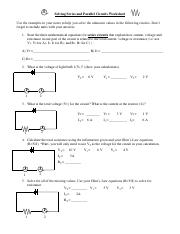
Determine the total voltage (electric potential) for each of the following circuits below.
Fill out the table for the. R eq = ____16 ___ 2. This lesson focuses on how this type of connection affects the relationship between resistance, current, and voltage drop values for individual resistors and the overall resistance, current, and voltage drop values for the entire … Calculate (a) the potential difference across each resistor, (b) the effective resistance, r of the circuit, (c) the current, i, in the circuit, (d) the currents, i 1, i 2 and i 3 passing through each resistor. Parallel dc circuits practice worksheet with answers worksheet In the case of a parallel configuration, each resistor has the same potential drop across it, and the currents through each resistor may be different, depending on the resistor. Then calculate total circuit current and the voltage drops and currents for each of the resistors. Experiment with an electronics kit! Circuitb was made by adding 2 more. View the circuit as a schematic diagram, or switch to a lifelike view. Determine the equivalent (total) resistance for each of the following circuits below. 7 4 parallel lines and proportional parts worksheet answers (a) since this is a parallel.
Parallel Circuit Worksheet Answers : Series And Parallel Circuit Worksheet Problems Physics Docsity /. Parallel dc circuits practice worksheet with answers worksheet Voltage (v) current (a) resistance (ω) 1. Determine the equivalent (total) resistance for each of the following circuits below. Circuitb was made by adding 2 more. Experiment with an electronics kit!

Posting Komentar